In case you missed it, like I did, TikTok quietly rolled out an update that doubles the length of user bios. It was previously only 80 characters, but it is now 160 characters, which feels luxurious by comparison. Thanks to this update, I am now able to better describe what my channel is about, as well as tag my other accounts. I do not know why TikTok did not make a bigger deal out of this. I never even got a notification about it & just found out randomly last night, but it is a welcome addition. If you have always wanted to add more information to your profile, now is your chance to update it.
Please note: I am only providing this information for TikTok users outside of the US. American TikTok is owned by a separate entity which I am boycotting. Because of this, I removed all the content from my previous channel after even support would not help me change its region to Japan.
Unless otherwise noted, image assets above are NOT original content & are shared under fair use doctrine with NO claims to authorship or ownership. Contact necrolicious@necrolicious.com for credit or removal.
This post was sponsored by…ME! If you’d like to support, please buy my original meme merchandise or check out my affiliate links to get yourself some other cool things. Additional affiliate links may be contained in the above article. If you click on an affiliate link & sign up/make a purchase, I may earn a commission. This does not increase the price you pay for the product or service, so it helps support this website at no cost to you.
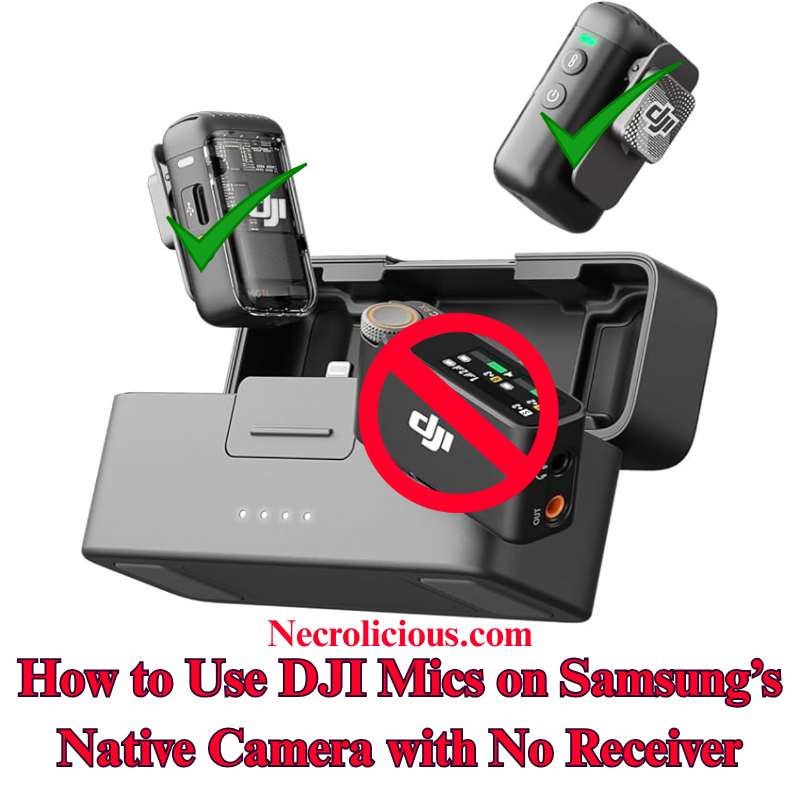
Not even all that long ago, I wrote & provided video instructions for how to use DJI Mic devices without receivers. However, in recent weeks, many content creators, particularly on Youtube, have been going crazy over a supposedly “secret” item: a mobile receiver that DJI quietly released for content creators who use their phones to record.
This secret item has frequently sold out to the point that many people are paying exorbitantly high markups on eBay & the like just to get their hands on one. So I’m here to remind you that you don’t actually need this device. I don’t say that just in the general sense that you should forgo all worldly possessions, give up on your content creation dreams & become a monk, but to show you again how you can get this device’s functionality, FOR FREE, without the need or use of any external receiver.
Starting off with iPhone since you people may well not be able to use this receiver, should you even be able to get your hands on one, due to the fact that it only comes in a USB-C configuration & is incompatible with older iPhone devices with Lightning ports.
Install RØDE Reporter: Search for “RØDE Reporter” in the App Store (don’t worry, it’s free–no signup or subscription necessary), download it, & grant microphone permissions when prompted.
Connect DJI Mic 2 via Bluetooth: Press & hold the pairing button on the DJI Mic 2 transmitter until the indicator flashes, entering pairing mode. On your iPhone, navigate to Settings > Bluetooth & select the DJI Mic 2 (it may appear as “headphones”).
Confirm Connection in RØDE Reporter: Launch the app & verify it displays “External Microphone” rather than “Internal Microphone,” indicating the DJI Mic 2 is connected.
Open the Native Camera App: Keep RØDE Reporter running in the background. Launch the iPhone’s Camera app, select Video mode, & the DJI Mic 2 will capture audio wirelessly.
Record Your Video: Begin recording. Create a short test clip to ensure audio quality & levels are satisfactory.
NOTE: The Bluetooth connection may route audio output to the DJI Mic 2, which lacks speakers. Disable Bluetooth or power off the Mic 2 to hear playback through your iPhone speakers after recording.
Much easier than iPhone, there’s no need for you to download anything, simply go to your native camera app & enter Pro Video mode to pair your DJI Mic via Bluetooth.
Connect DJI Mic 2 via Bluetooth: Power on the DJI Mic 2 transmitter. Press and hold the record button (link button) for three seconds until the status indicator flashes blue, entering Bluetooth pairing mode. On your Samsung Galaxy device, navigate to Settings > Connections > Bluetooth, ensure Bluetooth is enabled & select “DJI Mic 2” from the list of available devices (it may appear as a headset or microphone). Confirm any pairing prompts. The indicator will turn solid blue once connected.
Launch the Native Camera Application in Pro Video Mode: Open the stock Camera application on your Samsung Galaxy device. Swipe left or tap “MORE” at the bottom, then select “PRO VIDEO”. This mode provides advanced controls, including the ability to select external audio inputs.
Select the DJI Mic 2 as Audio Input: In Pro Video mode, locate the audio settings icon (typically a microphone symbol) above or near the record button on the right side of the screen. Tap it to access the audio source menu. Choose “Bluetooth” or “External Mic” (it may list the DJI Mic 2 directly). Ensure the internal microphone is disabled if prompted. The application will now utilise audio from the DJI Mic 2.
Record Your Video: Adjust video parameters such as resolution, frame rate, or exposure as required. Press the record button to begin capturing video. The DJI Mic 2 will wirelessly record high-quality audio synchronised with your footage. Record a short test clip to verify audio levels and clarity.
At its original $15 MSRP this mobile receiver that DJI released was generously priced. However, generous pricing proves futile with minimal supply, as evidenced by the secondary market AKA scalpers selling the DJI mobile receiver several times its original price. Still, armed with my how-to instructions above, you no longer need to purchase one at all so you can use that money you saved to buy yourself a shirt on the Necrolicious Store to look cool in all the videos you record.
Unless otherwise noted, image assets above are NOT original content & are shared under fair use doctrine with NO claims to authorship or ownership. Contact necrolicious@necrolicious.com for credit or removal.
This post was sponsored by…ME! If you’d like to support, please buy my original meme merchandise or check out my affiliate links to get yourself some other cool things. Additional affiliate links may be contained in the above article. If you click on an affiliate link & sign up/make a purchase, I may earn a commission. This does not increase the price you pay for the product or service, so it helps support this website at no cost to you.
My former employer, Apple, is turning heads. Not for releasing amazing cutting edge technology as fans previously could have rightfully assumed, but for selling what many are calling a stretched out sock for 40,000 yen. You read that right, this sock costs more than a new Apple Watch.
Once renowned as a leader in technological innovation, Apple has really reached a new low with this in my opinion. There’s nothing “tech” about a sock that probably costs them less than 10 cents to make. It’s not even a prestigious rare, valuable fabric, but a standard 85% polyester blend. The Issey Miyake branding deal undoubtedly inked to lend this pathetic release with any sort of credence probably costed more than all of materials/production cost of the actual items combined. I wouldn’t be able to help but lose respect for anyone I see using this product that they could make for themselves in seconds for 50 yen with just a knife & a knee-high sock bought at a 100 yen store. To own this Apple product is really a testament to both incompetence & apathy.
Frequently, obviously struggling to innovate beyond copying Android features from 5-10 years prior since his passing, it has repeatedly been said that Steve Jobs has been rolling in his grave at what has become of his company, but at this point we may well assume this latest release has turned him into the Looney Tunes Tasmanian Devil down there.
Unless otherwise noted, image assets above are NOT original content & are shared under fair use doctrine with NO claims to authorship or ownership. Contact necrolicious@necrolicious.com for credit or removal.
This post was sponsored by…ME! If you’d like to support, please buy my original meme merchandise or check out my affiliate links to get yourself some other cool things. Additional affiliate links may be contained in the above article. If you click on an affiliate link & sign up/make a purchase, I may earn a commission. This does not increase the price you pay for the product or service, so it helps support this website at no cost to you.
Following extensive online research and testing, I have confirmed that connecting the DJI Mic 2 wirelessly to a Samsung Galaxy device’s native Camera application is significantly more straightforward than on other platforms. Unlike iOS, which restricts Bluetooth audio input in its Camera application, Samsung’s One UI enables direct selection of external Bluetooth microphones within the Pro Video mode of the stock Camera application. This eliminates the need for third-party applications or additional adapters, offering a seamless solution for creators seeking high-quality audio without extra equipment. I have tested & verified this method on recent Samsung Galaxy models, including the S23 & S24 series, using the DJI Mic 2 transmitter directly. This approach is likely to function with other Bluetooth microphones from various brands, though I have not tested alternatives such as the DJI Mic Mini or Mic 3. If you experiment with a different Bluetooth microphone, please share your results in the comments below.
Why This Method is Valuable
The DJI Mic 2 delivers exceptional audio quality, with features such as 32-bit float internal recording and intelligent noise cancellation. However, the receiver adds unnecessary cost & complexity for mobile video production. Samsung’s native support for Bluetooth microphones in Pro Video mode provides a cost-effective, portable solution that maintains professional audio standards, simplifying the recording process for creators.
Step-by-Step Guide to Recording Video with DJI Mic 2, No Receiver
Connect DJI Mic 2 via Bluetooth: Power on the DJI Mic 2 transmitter. Press and hold the record button (link button) for three seconds until the status indicator flashes blue, entering Bluetooth pairing mode. On your Samsung Galaxy device, navigate to Settings > Connections > Bluetooth, ensure Bluetooth is enabled & select “DJI Mic 2” from the list of available devices (it may appear as a headset or microphone). Confirm any pairing prompts. The indicator will turn solid blue once connected.
Launch the Native Camera Application in Pro Video Mode: Open the stock Camera application on your Samsung Galaxy device. Swipe left or tap “MORE” at the bottom, then select “PRO VIDEO”. This mode provides advanced controls, including the ability to select external audio inputs.
Select the DJI Mic 2 as Audio Input: In Pro Video mode, locate the audio settings icon (typically a microphone symbol) above or near the record button on the right side of the screen. Tap it to access the audio source menu. Choose “Bluetooth” or “External Mic” (it may list the DJI Mic 2 directly). Ensure the internal microphone is disabled if prompted. The application will now utilise audio from the DJI Mic 2.
Record Your Video: Adjust video parameters such as resolution, frame rate, or exposure as required. Press the record button to begin capturing video. The DJI Mic 2 will wirelessly record high-quality audio synchronised with your footage. Record a short test clip to verify audio levels and clarity.
How It Works
Samsung’s One UI, built on Android’s Bluetooth audio framework, supports external microphone input in Pro Video mode without the restrictions found in iOS. Once paired, the DJI Mic 2 functions as a standard Bluetooth audio device & Pro Video mode allows explicit selection of the input source. This ensures real-time wireless audio capture directly within the native application, eliminating the need for additional software or hardware.
Additional Guidance
Gain Adjustment: Adjust the DJI Mic 2’s gain settings via its built-in touchscreen or the DJI Mimo application (if installed) before recording. Test clips are recommended to ensure optimal audio levels in varied environments.
Firmware & Software Updates: Keep the DJI Mic 2 firmware updated via the DJI Mimo application, and ensure your Samsung Galaxy device runs the latest Android/One UI version to prevent connectivity issues.
Limitations for Live Streaming: This Bluetooth method may introduce slight latency, making it less suitable for live streaming. For such applications, consider using the wired receiver connected via a USB-C adapter.
Alternative Applications: If Pro Video mode is unavailable or you encounter issues, applications such as Open Camera or Blackmagic Camera support Bluetooth microphones and can serve as alternatives. However, for seamless integration, the stock Camera application is recommended. Note that older Samsung models with Exynos processors (e.g., pre-S21 European variants) may have compatibility limitations; Snapdragon-based devices, such as the S23 or S24 series, perform optimally.
Stereo Recording: For dual transmitters, pair both via Bluetooth, but verify stereo support in Pro Video settings, as mono is the default. Full stereo recording may require the receiver.
This method enables creators to capture professional-grade video & audio using the DJI Mic 2 with Samsung’s native Camera application, without requiring a receiver. Have you tested this approach on your Galaxy device, or discovered alternative solutions? Please share your feedback in the comments & distribute this guide to assist fellow aspiring videographers.
For those preferring a complete setup, the full DJI Mic 2 kit, including the receiver, ensures broader compatibility. With the recent release of the Mic 3, prices for the Mic 2 have reached their lowest levels, making it an excellent time to consider purchasing.
Unless otherwise noted, image assets above are NOT original content & are shared under fair use doctrine with NO claims to authorship or ownership. Contact necrolicious@necrolicious.com for credit or removal.
This post was sponsored by…ME! If you’d like to support, please buy my original meme merchandise or check out my affiliate links to get yourself some other cool things. Additional affiliate links may be contained in the above article. If you click on an affiliate link & sign up/make a purchase, I may earn a commission. This does not increase the price you pay for the product or service, so it helps support this website at no cost to you.
After extensive online research, I found no clear instructions for using the DJI Mic 2 wirelessly with the iPhone’s native Camera app for video recording. Consulting Grok, I developed a straightforward method using Bluetooth, eliminating the need for a receiver. I’m sharing this guide to help creators achieve high-quality audio with their DJI Mic 2 on the iPhone’s default Camera app, avoiding additional equipment costs. Note that I have tested & confirmed that this method works with the DJI mic 2. I highly suspect that it may also work with other Bluetooth microphones, including those by other brands, but I do not have the DJI Mic Mini or the DJI Mic 3, nor do I have other brands to test with. If you have another brand of Bluetooth microphone, please give it a try & comment below if it works.
Why This Method is Valuable
The DJI Mic 2 offers exceptional audio quality, but its Bluetooth functionality isn’t natively supported by the iPhone’s Camera app for video. Purchasing the receiver increases expense & setup complexity. This cost-free solution, utilising the RØDE Reporter app, ensures a portable, wireless recording experience.
Step-by-Step Guide to Recording Video with DJI Mic 2 with no Receiver
Install RØDE Reporter: Search for “RØDE Reporter” in the App Store, download it, & grant microphone permissions when prompted.
Connect DJI Mic 2 via Bluetooth: Press & hold the pairing button on the DJI Mic 2 transmitter until the indicator flashes, entering pairing mode. On your iPhone, navigate to Settings > Bluetooth & select the DJI Mic 2 (it may appear as “headphones”).
Confirm Connection in RØDE Reporter: Launch the app & verify it displays “External Microphone” rather than “Internal Microphone,” indicating the DJI Mic 2 is connected.
Open the Native Camera App: Keep RØDE Reporter running in the background. Launch the iPhone’s Camera app, select Video mode, & the DJI Mic 2 will capture audio wirelessly.
Record Your Video: Begin recording. Create a short test clip to ensure audio quality & levels are satisfactory.
NOTE: The Bluetooth connection may route audio output to the DJI Mic 2, which lacks speakers. Disable Bluetooth or power off the Mic 2 to hear playback through your iPhone speakers after recording.
How It Works
iOS restricts Bluetooth microphones in the native Camera app. By activating the Bluetooth audio session in RØDE Reporter, the connection persists when switching to the Camera app, enabling wireless audio capture.
Additional Tips
Record a test clip to adjust the mic’s gain via its settings.
Ensure the DJI Mic 2 firmware & iOS are updated to prevent connectivity issues.
For live streaming, this method is unreliable; use the wired receiver instead.
Another option for using the DJI Mic 2 & other Bluetooth microphones is to download the Blackmagic Camera app & record using it instead of the native iPhone camera, but some users have reported issues with file management using this app, so this article’s method is best for those who prefer to use the native iPhone camera rather than 3rd party camera apps.
This method enables creators to record professional-grade video audio with the DJI Mic 2 on the iPhone’s native Camera app, without a receiver. Have you tested this approach or discovered other solutions? Share your feedback below & distribute this guide to assist fellow creators.
Of course, if you want to avoid the added hassle of such workarounds, you can buy the real thing, transmitter included. Prices on the Mic 2 recently dropped to record lows with the release of the Mic 3, so there has never been a better time to buy!
Unless otherwise noted, image assets above are NOT original content & are shared under fair use doctrine with NO claims to authorship or ownership. Contact necrolicious@necrolicious.com for credit or removal.
This post was sponsored by…ME! If you’d like to support, please buy my original meme merchandise or check out my affiliate links to get yourself some other cool things. Additional affiliate links may be contained in the above article. If you click on an affiliate link & sign up/make a purchase, I may earn a commission. This does not increase the price you pay for the product or service, so it helps support this website at no cost to you.
The world of survival horror is about to get a spine-tingling upgrade, as Koei Tecmo & Team Ninja have officially unveiled the remake of Fatal Frame II: Crimson Butterfly. Announced during a Nintendo Direct presentation on 12 September 2025, this full remake promises to breathe new life into one of the most beloved entries in the iconic Japanese horror series. If you’re a fan of ghostly encounters, atmospheric dread, & the thrill of snapping spirits with a spectral camera, this is the news you’ve been waiting for. Let’s dive into the eerie details of this haunting revival.
The Haunting Legacy of Fatal Frame II: Crimson Butterfly
Originally released in 2003 for the PlayStation 2 (known as Zero ~Akai Chō in Japan & Project Zero II: Crimson Butterfly in Europe), Fatal Frame II: Crimson Butterfly quickly established itself as a cornerstone of the survival horror genre. The story centres on twin sisters Mio & Mayu Amakura, who return to a childhood spot only to be lured by a mysterious crimson butterfly into the fog-shrouded Minakami Village – a place doomed to be submerged by a dam & now lost to maps.
In the village, the sisters uncover a dark ritual called the Crimson Sacrifice, where participants are brutally slain to appease restless spirits. Players control Mio as she searches for Mayu, using the legendary Camera Obscura – a haunted antique camera that captures & exorcises ghosts. The game’s fixed-camera exploration, tense combat, & psychological horror elements made it a standout, earning praise for its narrative depth, emotional sibling bond, & unforgettable scares like the infamous “Bloody Kimono” ghost.
This isn’t the first time Crimson Butterfly has been revisited; a Wii remake in 2012 (Japan-only, with European & Australian releases as Project Zero 2: Wii Edition) updated the graphics & controls using mechanics from Fatal Frame IV: Mask of the Lunar Eclipse. Yet, with modern hardware now available, fans have clamoured for a proper next-gen overhaul. Koei Tecmo’s announcement delivers just that, positioning this as the definitive way to experience the classic.
What’s New in the Fatal Frame 2: Crimson Butterfly Remake?
This remake isn’t a mere remaster – it’s a complete reimagining designed to honour the original while embracing contemporary standards. Publisher Koei Tecmo & developer Team Ninja (known for action-horror hits like Dead or Alive & recent Fatal Frame revivals) are overhauling key aspects to heighten the terror:
Stunning Visuals & Audio Overhaul: Expect breathtaking graphics that capture the misty, decaying beauty of Minakami Village in high definition. The trailer showcases improved lighting, detailed environments, & more lifelike animations for the vengeful ghosts. Audio enhancements will amplify the creaking floors, distant whispers, & heart-pounding soundtrack, including the haunting theme song “Chō” by singer-songwriter Tsukiko Amano.
Updated Gameplay & Controls: The core Camera Obscura mechanics return, but with refinements for smoother combat & exploration. Modern controls make aiming & evasion more intuitive, reducing clunkiness from the PS2 era. Pacing tweaks ensure the story flows better, while expanded features might include quality-of-life improvements like adjustable difficulty or new collectibles. The over-the-shoulder camera from the Wii version is likely retained for immersion.
Faithful Yet Fresh Narrative: The emotional core – the sisters’ bond amid supernatural horror – remains intact, complete with multiple endings (including the canon one tying into Fatal Frame III: The Tormented). Subtle additions could enhance the lore, but the developers emphasise staying true to the 2003 vision.
The announcement trailer, which you can find on the official Koei Tecmo site or YouTube, teases these upgrades with glimpses of crimson butterflies fluttering through darkened halls & ghostly apparitions lunging from the shadows. It’s a perfect blend of nostalgia & innovation, ensuring the remake feels both timeless & terrifyingly current.
Platforms, Release Date, & Languages
Fatal Frame II: Crimson Butterfly Remake is coming to a wide array of platforms, making it accessible to horror enthusiasts everywhere:
PlayStation 5
Xbox Series X|S
Nintendo Switch 2
PC (via Steam)
A release window of early 2026 has been confirmed, though an exact date is yet to be revealed. This timing positions it as a prime Halloween-season contender, potentially clashing with heavyweights like the rumoured Resident Evil: Requiem but carving out its niche in Japanese folklore-inspired scares.
Language support includes Japanese voice acting – essential for the series’ authentic tone – alongside English, French, German, Italian, & Spanish subtitles. No word yet on additional dubs, but the focus on localisation suggests broad appeal.
Why This Remake is Pivotal for Horror Fans
In an era dominated by jump scares & action-heavy titles, Fatal Frame II: Crimson Butterfly Remake stands out by prioritising psychological dread & cultural depth. The series has seen a revival spark with the 2021 Fatal Frame: Maiden of Black Water remaster, proving there’s appetite for ghost-hunting adventures. As the most acclaimed entry (often hailed as the best alongside Silent Hill 2), this remake could reignite interest in the franchise, potentially paving the way for more – perhaps even a Fatal Frame 1 overhaul.
Fan reactions have been overwhelmingly positive, with communities on Reddit, ResetEra, & Twitter buzzing about reliving childhood nightmares. “One of the scariest games I’ve ever played,” one enthusiast noted, while others celebrate the IP’s survival after years of dormancy. Whether you’re a series veteran or new to the Camera Obscura’s flash, this remake promises to deliver chills that linger long after the credits roll.
Get Ready for the Crimson Butterfly’s Return
Mark your calendars for early 2026 – Fatal Frame II: Crimson Butterfly Remake is poised to haunt consoles & PCs alike. Head to the official website at koeitecmoamerica.com for trailers, screenshots, & updates. If survival horror with a supernatural twist is your jam, this is the remake to watch. Will you dare to follow the crimson butterfly into the unknown? The spirits are waiting.
Unless otherwise noted, image assets above are NOT original content & are shared under fair use doctrine with NO claims to authorship or ownership. Contact necrolicious@necrolicious.com for credit or removal.
This post was sponsored by…ME! If you’d like to support, please buy my original meme merchandise or check out my affiliate links to get yourself some other cool things. Additional affiliate links may be contained in the above article. If you click on an affiliate link & sign up/make a purchase, I may earn a commission. This does not increase the price you pay for the product or service, so it helps support this website at no cost to you.
As of today, September 13, 2025, TikTok’s 170 million American users are being involuntarily shifted to M2, a U.S.-exclusive app launched by ByteDance on September 5 to comply with U.S. data security laws. This forced migration isolates U.S. users from the global TikTok community, likely curbing creators’ international reach & drawing sharp criticism for fracturing a platform once celebrated for its global connectivity.
During the brief January 2025 blackout, frustrated users flocked to Red Note, a Chinese app similar to TikTok, to protest, voicing distrust in the app’s future & government oversight, with some suspecting an attempt to conceal Israel’s actions in Palestine & Gaza as well as censor American voices critiquing them—concerns heightened by the recent appointment of Erica Mindel, a former IDF soldier, as TikTok’s Public Policy Manager for Hate Speech to oversee content moderation.
With ByteDance facing a September 17, 2025, deadline to sell TikTok’s U.S. operations to an American buyer, failure to do so could trigger a permanent blackout of American accounts in early 2026. Many users & creators now question whether M2 is a genuine solution or a superficial fix that risks eroding TikTok’s vibrant ecosystem under the weight of regulatory pressures.
In the months leading up to this forced migration, I made many attempts to reach out to TikTok support in order to change my Necrolicious account location from the US to Japan since the option to do so manually disappeared on this account. I created numerous support tickets. Each ticket received canned replies of “If we need anything else, we’ll contact you” & simply closed without any resolution, no matter how many follow-up messages I sent. I recently gave up & simply started a new account for the Japan region, which you can find here:
Additionally, I have been uploading copies of my videos to YouTube & actually have much better reach on that platform, with one recent video breaking out to nearly 110,000 views.
I also made a counterpart account for English uploads on both platforms, but have not yet utilised them. I am simply unsure if the demand for English content is insufficient to warrant doubling my video creation workload. Besides that, there are so many English content creators in Japan already. It seems like the market is saturated & I would rather connect with Japanese audiences. If you think I should start creating content in English, tell me in the comments below.
Unless otherwise noted, image assets above are NOT original content & are shared under fair use doctrine with NO claims to authorship or ownership. Contact necrolicious@necrolicious.com for credit or removal.
This post was sponsored by…ME! If you’d like to support, please buy my original meme merchandise or check out my affiliate links to get yourself some other cool things. Additional affiliate links may be contained in the above article. If you click on an affiliate link & sign up/make a purchase, I may earn a commission. This does not increase the price you pay for the product or service, so it helps support this website at no cost to you.
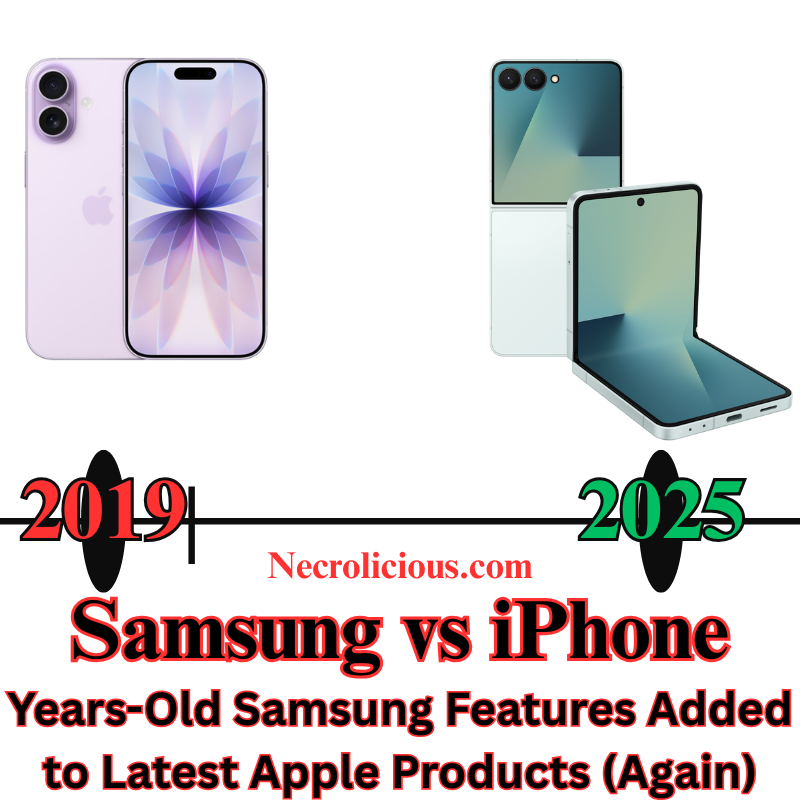
At Apple’s highly anticipated “Awe Dropping” event on 9 September 2025, the tech giant unveiled a slew of new products & features, including the iPhone 17 series (with the all-new iPhone Air), Apple Watch Series 11, Apple Watch Ultra 3, Apple Watch SE 3, & AirPods Pro 3. Held at its Cupertino headquarters, the event generated significant buzz around hardware refinements & incremental AI updates. However, several showcased features have been available on Samsung devices for some time. From live translation in earbuds to AI-powered functionalities, Samsung has been setting the pace in these areas, whilst Apple’s recent innovations, including its much-touted Apple Intelligence, appear to be playing catch-up. This article explores the key features Apple promoted at its latest event & how Samsung has long offered similar capabilities in its Galaxy ecosystem.
Live Translation: AirPods Pro 3 vs Galaxy Buds
One of the standout features Apple highlighted for the AirPods Pro 3 was Live Translation, a capability that allows users to hear real-time translations of in-person conversations directly through their earbuds. Powered by Apple Intelligence & iOS 26, this feature enables users to communicate across select languages (such as English, French, German, Portuguese, & Spanish) by translating speech into the user’s preferred language in their earbuds, whilst the iPhone displays or speaks the translated response for the other party. Apple positioned this as a transformative tool for travel, work, & cross-lingual communication, available in beta with the AirPods Pro 3, AirPods Pro 2, & AirPods 4 with Active Noise Cancellation (ANC).
However, Samsung has offered a similar feature, called Live Translate, on its Galaxy Buds series since early 2024. Compatible with devices like the Galaxy S24, Galaxy Z Fold6, & Galaxy Z Flip6, Samsung’s Live Translate works through the Galaxy Wearable app & Galaxy AI suite, enabling real-time translation during phone calls & in-person conversations. Users can hear translations through their Galaxy Buds, Buds Pro, or Buds FE, with the phone displaying or speaking the translated text for the other party. Unlike Apple’s implementation, which requires specific AirPods models with the H2 chip, Samsung’s feature supports a broader range of its earbuds & works offline with pre-downloaded language packs, offering greater versatility for users in areas with limited connectivity.
Samsung’s Interpreter Mode, another Galaxy AI feature, further enhances this capability by providing split-screen translations for in-person conversations, making it a robust tool for multilingual interactions. Whilst Apple’s Live Translation is a welcome addition, it’s not a novel concept, as Samsung has been refining this technology for over a year, with support for 13 languages & counting.
Apple Intelligence vs Galaxy AI: A Delayed Promise
Apple’s event also emphasised Apple Intelligence, the company’s AI platform, which powers features like Live Translation, Workout Buddy for fitness motivation, & visual intelligence for tasks like calendar integration. However, Apple Intelligence was notably understated during the event, with CEO Tim Cook focusing more on hardware improvements than AI as a consumer-facing feature. Reports suggest Apple is still catching up in the AI race, with some of its promised features from WWDC 2025, such as advanced Siri upgrades, delayed or scaled back—pushing key capabilities like enhanced Siri to 2026.
In contrast, Samsung’s Galaxy AI, introduced with the Galaxy S24 series in late 2023, has been a cornerstone of its ecosystem for nearly two years. Galaxy AI powers a wide range of features, including Live Translate, Interpreter Mode, Chat Assist for message tone-checking, Transcript Assist for multilingual summaries, & Circle to Search for translating on-screen content. These tools are deeply integrated across Samsung’s flagship devices, including the Galaxy S25, Z Fold7, & Z Flip7, & are available both on-device & via the cloud, with offline functionality for many features. Samsung’s head start in AI development has allowed it to offer a more mature & versatile suite compared to Apple Intelligence, which is still in beta & limited to select devices & languages. Features like Magic Cue—proactively surfacing information across apps—& advanced photo search via Google Gemini integration feel futuristic, leaving Apple’s current offerings, like basic Genmoji, several steps behind.
iPhone Air vs Galaxy S25 Edge: The Thin Phone Race
Apple’s introduction of the iPhone Air, a 5.5mm-thick model billed as the thinnest iPhone ever, was a headline-grabbing moment at the event. Marketed as a sleek addition to the iPhone 17 lineup at $999, it aims to compete in the ultrathin smartphone market with a 6.5-inch display & Ceramic Shield 2 protection.
However, Samsung beat Apple to the punch with the Galaxy S25 Edge, launched in May 2025, which measures just 5.4mm thick—0.2mm slimmer than the iPhone Air. Samsung’s device also integrates bold AI features &, in some configurations, foldable screen technology, offering a unique form factor that Apple’s iPhone Air does not match. Whilst Apple’s design is undeniably elegant, Samsung’s earlier entry into the thin-phone market & its incorporation of foldable displays in devices like the Galaxy Z Fold7 & Z Flip7 demonstrate a more ambitious approach to hardware innovation. Apple’s rumoured foldable iPhone, expected in 2026, suggests it’s still a year behind Samsung in this space.
Vapour Chamber Cooling: iPhone 17 Pro vs Galaxy Devices
The iPhone 17 Pro & Pro Max introduced a vapour chamber cooling system to manage heat dissipation during high-performance tasks like gaming & video capture. This marks a shift from Apple’s traditional graphite-based cooling, aligning with high-end Android competitors. The vapour chamber, combined with an aluminium frame, enhances thermal performance, preventing throttling & supporting demanding workloads.
Samsung, however, has implemented vapour chamber cooling in its flagship devices since the Galaxy S20 series (2020). Models like the Galaxy S24 Ultra, Z Fold6, & S25 Edge use advanced vapour chambers to dissipate heat from high-performance chips, enabling sustained performance during gaming & multitasking. Samsung’s cooling systems have been optimised for foldable devices, which face unique thermal challenges due to their compact designs, giving Samsung a five-year head start over Apple’s adoption of this technology.
Camera Systems: 48MP Across the Board vs Samsung’s High-Resolution Sensors
The iPhone 17 series features a 48MP Fusion Main camera, a 48MP Fusion Ultra Wide camera, & an 18MP Center Stage front camera across all models, with the Pro models adding a 48MP telephoto lens supporting 4x-8x optical zoom. These upgrades enable advanced computational photography & macro photography, powered by an updated image signal processor (ISP).
Samsung has offered high-resolution camera sensors for years, with the Galaxy S23 Ultra (2023) & S24 Ultra (2024) featuring a 200MP main camera using the ISOCELL HP2 sensor. This allows for greater detail & cropping flexibility compared to Apple’s 48MP sensors, which are only now catching up in resolution but lack the pixel density of Samsung’s offerings. The Galaxy S25 series continues this trend, with a 200MP main sensor & a 50MP ultra-wide lens, outpacing Apple’s ultra-wide camera in resolution. Additionally, Samsung’s periscope telephoto lenses, introduced in the Galaxy S20 Ultra (2020), have offered 5x-10x optical zoom, surpassing Apple’s 8x zoom cap until the iPhone 17 Pro’s recent upgrade.
Health & Fitness Features: Apple Watch & AirPods vs Galaxy Wearables
Apple showcased health-focused updates, including heart rate tracking on the AirPods Pro 3 & blood pressure monitoring on the Apple Watch Series 11. The AirPods Pro 3’s heart rate sensor, which uses infrared light to measure blood flow, syncs with the Fitness app to track over 50 workout types, whilst the Apple Watch Series 11 introduces hypertension detection & a sleep score feature (pending FDA clearance). The Apple Watch Ultra 3 adds satellite connectivity & faster charging, with pricing starting at $749.
Samsung, however, has offered similar health features for some time. Galaxy Buds, such as the Buds3 Pro, have included heart rate monitoring since their 2024 release, particularly when paired with compatible Galaxy devices like the S24 or Z Fold6. Samsung’s Galaxy Watch series, including the Galaxy Watch7 (2025), has provided blood pressure monitoring & sleep tracking, including detailed sleep scores, for years, with some models receiving FDA clearance for these features well before Apple’s announced plans for FDA approval. Additionally, Samsung’s wearables integrate with the Samsung Health app, which offers broader ecosystem compatibility, including with non-Samsung Android devices, unlike Apple’s ecosystem-locked approach.
Active Noise Cancellation & Audio Quality
Apple touted the AirPods Pro 3’s Active Noise Cancellation (ANC), claiming it removes up to twice the noise of the AirPods Pro 2 & four times that of the original AirPods Pro. The earbuds also feature an updated design for better fit & enhanced spatial audio. Samsung’s Galaxy Buds3 Pro, however, have offered comparable ANC since their 2024 launch, with adaptive noise cancellation that adjusts to environmental sounds like alarms or sirens. The Buds3 Pro also include two-way speakers & planar magnetic tweeters for high-quality audio, supporting up to 24-bit/96kHz over Bluetooth on compatible devices—features that rival or surpass Apple’s spatial audio capabilities.
Foldable Devices: Apple’s Tease vs Samsung’s Dominance
Whilst Apple didn’t unveil a foldable iPhone at the event, analysts suggest the iPhone Air’s ultrathin design sets the stage for a foldable iPhone in 2026, likely adopting a book-style design similar to Samsung’s Galaxy Z Fold series.
Samsung has been a pioneer in foldable smartphones since the Galaxy Fold in 2019, with seven generations of refinement by 2025. The Galaxy Z Fold7 & Z Flip7, launched in mid-2025, feature durable hinges, 7.8-inch inner displays (Fold), & advanced multitasking capabilities powered by Galaxy AI. Samsung’s foldables have consistently offered larger, more versatile displays & productivity features that Apple’s rumoured foldable is only beginning to approach.
Whilst Apple’s “Awe Dropping” event showcased impressive hardware & promising AI-driven features, it’s clear that Samsung has been ahead in several key areas. Live Translate, a flagship feature for the AirPods Pro 3, has been a staple in Samsung’s Galaxy Buds since 2024, with broader language support & offline capabilities. Galaxy AI, now nearly two years old, offers a more mature & versatile suite of tools compared to the still-evolving Apple Intelligence. The iPhone Air, though sleek, follows in the footsteps of the Galaxy S25 Edge, & Samsung’s health & fitness features in its wearables have long matched or exceeded those introduced in Apple’s latest devices. Vapour chamber cooling, high-resolution 200MP cameras, & foldable devices have been staples of Samsung’s lineup since 2020 or earlier, whilst Apple is only now adopting these technologies.
Apple’s ecosystem integration & polish remain strong selling points, but Samsung’s earlier adoption of these technologies highlights its leadership in innovation. As Apple continues to roll out Apple Intelligence & refine its offerings, it will need to bring more unique features to the table to close the gap with Samsung’s established advancements. For now, Samsung’s Galaxy devices & wearables continue to set a high bar that Apple is striving to meet.
Unless otherwise noted, image assets above are NOT original content & are shared under fair use doctrine with NO claims to authorship or ownership. Contact necrolicious@necrolicious.com for credit or removal.
This post was sponsored by…ME! If you’d like to support, please buy my original meme merchandise or check out my affiliate links to get yourself some other cool things. Additional affiliate links may be contained in the above article. If you click on an affiliate link & sign up/make a purchase, I may earn a commission. This does not increase the price you pay for the product or service, so it helps support this website at no cost to you.
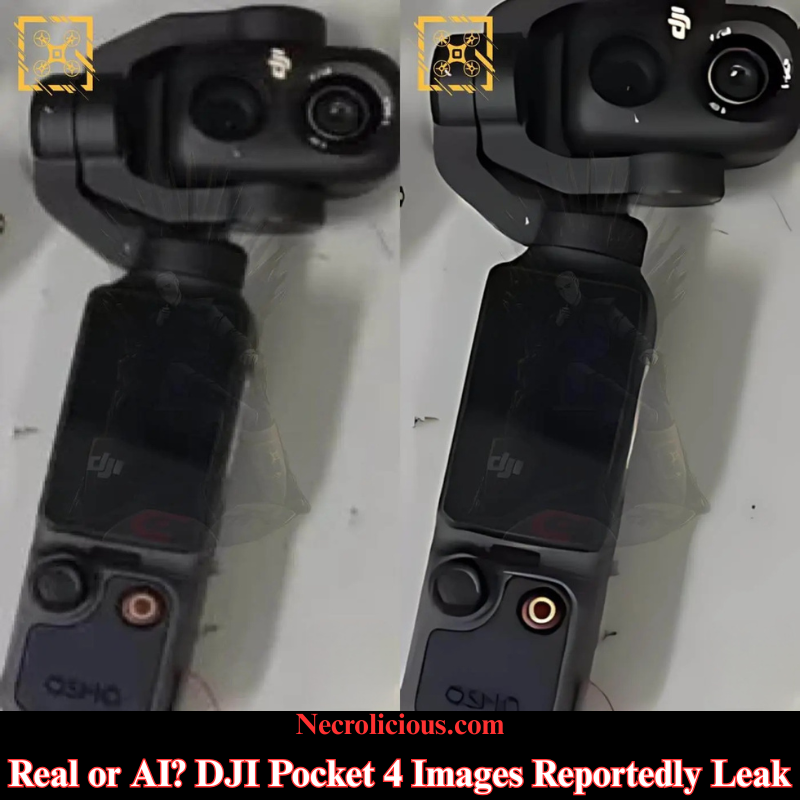
In a recent post on X, leaker Igor Bogdanov of Quadro News claims to have released exclusive photos of the DJI Osmo Pocket 4.
Purportedly, it sports 2 cameras. However, I am not convinced these images are real at all.
A closer look at his main post shows the kind of text rendering commonly found on AI generated images. Specifically, if you look at the word “OSMO” on the handle, you can tell that it is entirely inorganic as is the text found around the lens of the camera, which appears to be a random combination of the DJI logo as well as non existent letters & numbers in no particular sequence.
In the comments of his original post, he added an additional photo, which he claims was unedited.
Still, the question remains–was the photo he originally posted just an AI enhancement of his later image or was this story entirely fabricated?
Look closely at the images & comment your thoughts.
Unless otherwise noted, image assets above are NOT original content & are shared under fair use doctrine with NO claims to authorship or ownership. Contact necrolicious@necrolicious.com for credit or removal.
This post was sponsored by…ME! If you’d like to support, please buy my original meme merchandise or check out my affiliate links to get yourself some other cool things. Additional affiliate links may be contained in the above article. If you click on an affiliate link & sign up/make a purchase, I may earn a commission. This does not increase the price you pay for the product or service, so it helps support this website at no cost to you.
Samsung has two major events lined up for September 2025! The first kicks off at 2:30 AM PDT on Thursday, 4th September (that’s 18:30 JST), just hours from now, following the official teaser from Samsung Japan on 27th August. A second event, rumoured for 29th September, promises even more innovation.
The Initial Unveiling: 4th September 2025
Samsung Japan’s recent post uses the term “新製品” (shin-seihin), meaning “new products,” paired with a cool image of a glowing hexagonal box releasing starry lights. The character “品” (hin), which specifically points to tangible goods, hints that this event will likely showcase new hardware rather than just AI software tweaks. This ties into recent upgrades like the Galaxy Z Fold7 & Flip7 with Google’s Gemini AI from the July 2025 Unpacked event, but the focus on “products” suggests devices like the Galaxy S25 FE or regional exclusives might steal the show. Timed just before Apple’s expected fall launch, it looks like Samsung’s making a smart move to drop accessible hardware with a side of AI goodness. Don’t miss the livestream on Samsung’s official channels! You might see new devices with enhanced cameras, better multitasking, or other hardware perks, setting the stage for what’s next.
The Anticipated Major Event: 29th September 2025
Rumours from ZDNet & GSMArena point to a big Unpacked event on 29th September, where Samsung could unveil a tri-fold phone, an XR headset, & AI smart glasses. This lineup puts Samsung in the ring with Apple’s Vision Pro & Huawei’s Mate XT from September 2024. The tri-fold, with its dual-hinge design & Micro OLED panels powered by a Snapdragon XR2+ Gen 2 chip, plus an XR headset, could redefine foldables & mixed reality. Add in AI glasses, & you’ve got a wearable tech feast! GSMArena’s scoop about a limited tri-fold run suggests Samsung’s playing it safe to not overshadow the Z Fold7. A global livestream is on the cards, packed with demos to get you excited about these cutting-edge gadgets.
Strategic Rationale for Dual Events
Why two events? The 4th September launch seems to spotlight new hardware products, possibly with AI boosts, echoing Samsung’s “AI for All” tagline & its CES 2024 AI appliance showcase. The 29th September event, though, looks set for flagship hardware reveals, fitting the classic fall tech season. This dual approach lets Samsung cater to different crowds—mid-range or regional gear now, top-tier innovation later—keeping the competition on its toes.
Expected Product Launches
Here’s a handy table to sum up what might drop at each event, factoring in the “新製品” clue that leans towards hardware over just AI updates:
Event Date
Expected Products
Likelihood of Hardware vs. AI Updates
Details
4th September 2025
– Galaxy S25 FE – Possible Regional Exclusives
High likelihood of hardware (70-80%), with AI enhancements as a secondary focus
The term “新製品” points to new devices, likely mid-range like the S25 FE, with AI perks (e.g., camera, multitasking).
29th September 2025
– Tri-Fold Phone – XR Headset – AI Smart Glasses
Very high likelihood of hardware (90%), with AI integration
Flagship hits including a dual-hinge tri-fold, XR device with Snapdragon XR2+ Gen 2, & AI glasses, packed with advanced AI.
4th September: Set your alarm for 2:30 AM PDT & catch the livestream on Samsung’s official platforms. Expect new hardware with some AI flair!
29th September: Keep an eye on pre-event buzz & Samsung’s teasers for the tri-fold, XR, & AI glasses reveals.
Drop your predictions in the comments—rooting for new hardware or excited about AI upgrades? Let’s chat about it!
Unless otherwise noted, image assets above are NOT original content & are shared under fair use doctrine with NO claims to authorship or ownership. Contact necrolicious@necrolicious.com for credit or removal.
This post was sponsored by…ME! If you’d like to support, please buy my original meme merchandise or check out my affiliate links to get yourself some other cool things. Additional affiliate links may be contained in the above article. If you click on an affiliate link & sign up/make a purchase, I may earn a commission. This does not increase the price you pay for the product or service, so it helps support this website at no cost to you.
Share this:
Cookie Consent
We use cookies to improve your experience on our site. By using our site, you consent to cookies.
Registers a unique ID on mobile devices to enable tracking based on geographical GPS location.
1 day
VISITOR_INFO1_LIVE
Tries to estimate the users' bandwidth on pages with integrated YouTube videos. Also used for marketing
179 days
PREF
This cookie stores your preferences and other information, in particular preferred language, how many search results you wish to be shown on your page, and whether or not you wish to have Google’s SafeSearch filter turned on.
10 years from set/ update
YSC
Registers a unique ID to keep statistics of what videos from YouTube the user has seen.
Session
DEVICE_INFO
Used to detect if the visitor has accepted the marketing category in the cookie banner. This cookie is necessary for GDPR-compliance of the website.
179 days
LOGIN_INFO
This cookie is used to play YouTube videos embedded on the website.